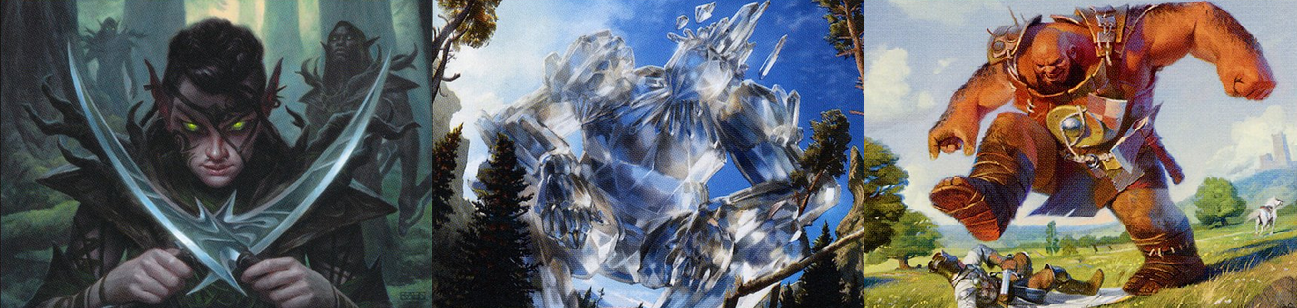
Gladiator is a format where you can build and play anything you want. Feel like playing Orzhov lifegain? Build it. Feel like playing Mono Blue? Done. Counterburn? Sure. With having access to every card on Arena, except for a couple, the format is everybody’s oyster when it comes to making a deck and jumping in the queues. That is the reason I love the format and think discussion on what to play and how to think about building is so fun. Traditional constructed formats tend to be “solved” fairly quickly, and the way I see it Singleton allows the games to be more about builds and lines of play than matchups and lucky draws.
With that said, while having the ability to build everything there tends to be successful archetypes. They may be successful because the archetypes are traditionally successful in 1 v. 1 strategies. They may be successful because a set or two gave them a lot of tools and brewers have learned the best way to build around them. Typically, the best decks and strategies have one of those or both reasons and more to why they are successful. But what makes successful decks successful? I looked at three 5-0 decks from the current league and break down the elements of their construction and strategy.
Element 1 | Having a Plan
This is the most important but also the hardest to define element of the successful deck in Gladiator. The idea of this element is at the end of construction you can identify the purpose or strategy of your deck and each card in your deck can be justified to serve them. Some of the most basic plans can include but are not limited to:
1. Killing Your Opponents as Fast as Possible (traditional aggro)
2. Killing Your Opponents Quickly while Controlling the Board (tempo)
3. Having Cheap Removal and Midgame Threats (traditional midrange)
4. Ramping Up to Big Plays (ramp midrange)
5. Board Wipes and Planeswalkers (traditional control)
6. Combo
When you can identify the plan of your deck, you can go back and see if any cards don’t really fit that plan. You probably shouldn’t play Merfolk Trickster in your control deck, because even though it is an early play it just dies to your board wipe and doesn’t hold off your opponents’ large creatures. You could cut your Burning Sun’s Avatar from your Mono Red deck, because you can’t justify its mana cost with your aggro plan. It is important to look at your deck like a puzzle with every card being a piece. Not every card should do the same thing, but should be balanced at the top and bottom of the curve with effects that fit your deck’s plan.
I chose the trophy decks based on their plans being clearly distinct and to a degree definable. Catmoozi’s 5-0 Mono Red list is the ultimate aggro deck topping the curve with Hazoret the Fervent and Torbran, Thane of Red Fell. The strategy is clear: cheap creatures to do quick damage and burn going to face if the opponent gets effective blockers.
BraveJRL’s 5-0 Mono Green list is what I’d call ramp midrange where the idea is to use early creature ramp to get out a 5-drop like Cavalier of Thorns to hold off aggro until it can win with Craterhoof Behemoth or just by swinging bigger creatures. While this deck can end up playing like an aggro deck with a turn 2 Yorvo, Lord of Garenbrig, it doesn’t have the typical removal suite and aggro deck would have and it aims to win a little later than turn 5.
Mana Vault’s 5-0 Azorius Control list works at every point in the game to block creatures effectively, counter spells, and control the board. With control classics like Wrath of God and Sphinx’s Revelation, this deck looks to survive to turn 8 and from there it looks to take over the game.

Element 2 | Early Plays (Answers for Aggro)
No matter what your plan is, your deck needs to play something before turn 4. Even against midrange, if you are not doing something before turn 4 you will probably fail fairly behind. Some of the most effective early plays are:
1. Cheap Creatures
2. Cheap Removal Spells
3. Cheap Ramp
4. Cheap Filtering/Card Draw
Although the idea of playing cheap spells is fairly simple, it is interesting to discuss the amount (through percentage) of cards you play should be three or less mana. That could depend on the impact of the spells in question or the amount of 4-drops the deck has that can really block up the board or act as removal.
Catmoozi’s Mono Red list is all cheap spells and in an aggro matchup just wants to be faster than the opponent like it would be with any matchup. Of note, this list has 14 1-drops creatures, 14 1-drop noncreatures counting Light Up the Stage and Skewer the Critics, and Embercleave which in some game states is just free.
BraveJRL’s Mono Green list has close to 40% of its spells for 3 or less mana which makes it very likely to have a play before turn 4. The cheap creatures aren’t just used as block fodder are used to ramp so that 4 drops come down as early plays as well.
Mana Vault’s Azorius List has multiple kinds of early plays to make up for its lack of early aggression. There are removal/pseudo removal spells like Seal Away and Blink of an Eye to slow down early creatures, The Birth of Meletis and Omen of the Sun for early chumps, and ramp like Mind Stone and Chromatic Lantern to play wraths earlier and have the mana for wincon haymakers like Ugin, the Spirit Dragon and Ulamog, the Ceaseless Hunger.
Element 3 | Closing Out the Game
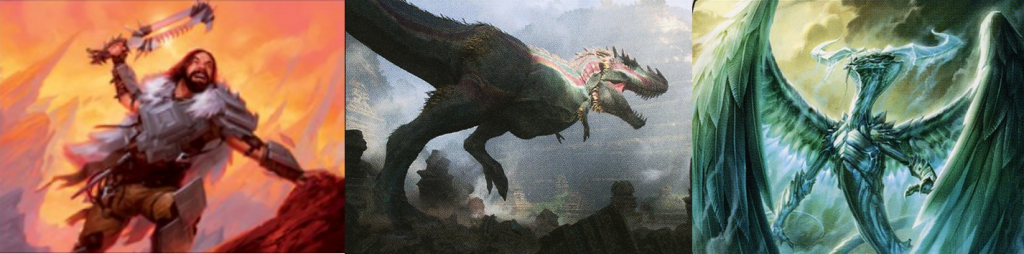
Just like your deck needs to have early plays, your deck needs to have a way to close out the game and enough of them. This element may be fairly simple for archetypes like midrange and combo, but can be more complex for aggro and control. For aggro, you may have a lot of cheap creatures, but have no answers for a big creature that the opponent plays that can block everything you have. In that case, you need to have burn to face to close out the game and you need to run enough of it to use some burn on their cheap blockers and have enough to burn them out in the end. For control, you can end up packing your list with removal and counterspells, but if you don’t have a way of taking the advantage in the late game then the aggro or midrange opponents can eke out enough advantage to win. That’s why you want to have at least and handful of wincons with a control deck just in case you have to bottom one early on a scry or discard it to dig for early plays. A nice advantage to have in your wincon slot is a card that can also be played as an early play.
The Mono Red list has access to variable-costed burn in Roil Eruption and also late game mana sinks in Hazoret the Fervent and Kargan Intimidator. It is also nice to have access to phoenix reanimation in Lightning Phoenix and Earthshaker Khenra.
Mono Green has its namesake of Craterhoof Behemoth as a clear ender, but there a several others that can do the job. Ghalta, Primal Hunger is a powerhouse, Biogenic Ooze takes over the board with tokens that continually grow, and Rhonas the Indomitable can pump in bigger swings to name a few.
Azorius Control plays a handful of wincons that come late in the game but are very hard to overcome. Ugin, the Spirit Dragon is one of the best, acting as an answer to your opponent’s board and a way to win out of nowhere. The list also has Dream Trawler and Teferi, Hero of Dominaria that can come down as midgame plays but if unanswered take over the game.
Element 4 | The Mana Base
Nobody what color identity your Gladiator deck ends up being, you will eventually need to work out the mana base. The analysis of your mana base should include the land count, color sources, number of modal dual faced cards (MDFCs), and number of tapped lands. This could end up being more complex than you care to calculate, so this will have to be tested with several reps. Here are the questions you should be asking yourself game to game:
1. Am I getting enough (2-4) lands in my opening hand? (land/MDFC count)
2. Do I have enough untapped lands to play my spells on time? (tapped land %)
3. Do I end games just hoping to not topdeck lands? (land/MDFC count)
4. Am I ever hindered by mana color restrictions in a game? (color sources)
Although it may seem silly to look at these questions, it is important to realize that most people don’t think about their mana base enough and it becomes a big factor game to game where it shouldn’t. If you feel like you are in a good spot as far as your mana base, here are some general tips for most mana bases in Gladiator that you can also utilize:
1. You should probably be playing the Mythic MDFCs in your colors. The life cost isn’t a big deal compared to the flexibility and ability for it to be untapped. You can also be playing the other MDFCs that fit your game plan.
2. Unless the list is ultra aggro, 2-color decks should be playing the Temples. Scrying becomes so much stronger when your deck is a toolbox like it is in Gladiator.
3. Control and lands decks should run more lands so that you can ensure land drops every turn.
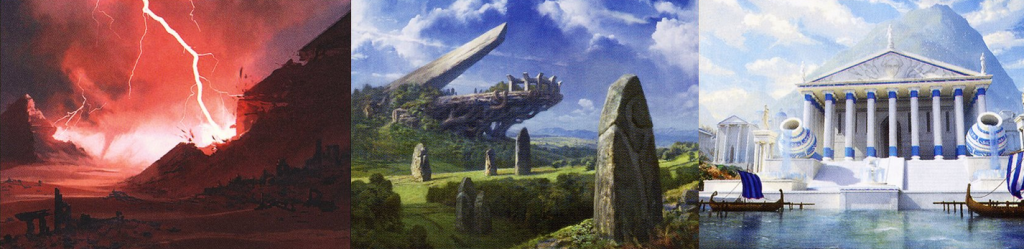
Utility lands are also important, because a lot of the time you will have extra mana and be able to use it. Having the Castle set from Throne of Eldraine and the uncommon Desert set from Amonkhet Remastered is a good start for your utility land suite. Catmoozi’s Mono Red list has Ramunap Ruins and Sunscorched Desert. BraveJRL’s Mono Green list has Castle Garenbrig and Hashep Oasis. Mana Vault’s Azorius List has Arch of Orazca, Castle Ardenvale, Karn’s Bastion, and Memorial to Genius along with a ton of fixing.
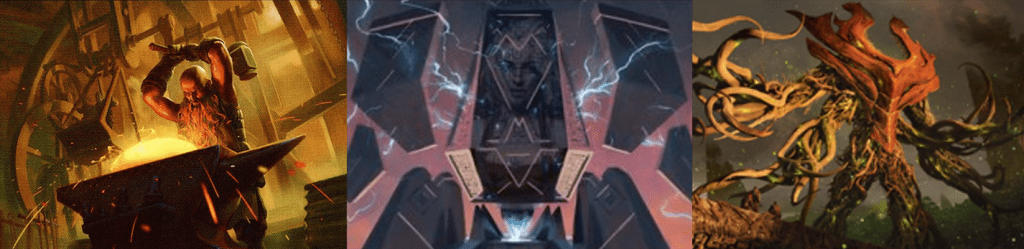
Element 5 | Innovation and Conclusion
It is great that Gladiator has access to the oldest cards on Arena so that you could make a deck and keep it as new sets keep being added. But it is also great that with each new set you get access to new kinds of effects that could make an existing deck stronger or make you want to change the plan of the deck entirely. Balancing the strength of established cards and strategies and the strength of new cards with possible power creep is a skill that each deckbuilder comes to terms with whenever a new set is printed and decks get updated.
Outside of the functionality of the decklist itself, there are a few of other factors that can determine the viability of certain strategies or interactions with opponents:
1. What is the current meta?
This could help you decide on what kind of deck to build in the first place but can also affect individual card includes. If the meta is all aggro, cheap board wipes life Deafening Clarion or Sweltering Suns may even be worth running in decks that have mana dorks just because you know aggro will fold to a wipe. Conversely, if the control is most of the meta it may be smart to make a hyper aggressive deck with cheap counterspells to counter any wipes.
2. How much has this strategy/interaction been seen?
Even with a fairly open meta, the card pool of Gladiator is so huge that many interactions may be misplayed because they haven’t been seen before. Maybe your opponent didn’t clearly read Lithoform Engine and when they try to remove one of your legendary permanents you just copy it and keep the token. Maybe your opponent doesn’t realize you have Never // Return in your graveyard and plays their Uro, Titan of Nature’s Wrath from hand and just as quickly has it exiled from their graveyard. There are so many cards to keep track of and the ones not as well-known may be easier to get people with.
As new sets come out, the pool for Gladiator will grow and new strategies will emerge. It’s exciting to not know the strongest possible deck and the variance of the singleton format will ensure that many strategies can be viable competitively. The elements of the successful decks in Gladiator provide a foundation for the format’s future, but when it comes to my decks I like to think of each of them as an extension of me depending on how I feel. Sometimes I feel like aggroing out. Sometimes I feel like slowing down and controlling the game. However I’m feeling, I’m grateful to have this format which both feels healthy and comforting.
Catmoozi’s Mono Red List – https://gladiator.emallson.net/deck/1139
BraveJRL’s Mono Green List – https://gladiator.emallson.net/deck/1196
Mana Vault’s Azorius List – https://gladiator.emallson.net/deck/1215
 MTG Gladiator
Lithoform engine only copies spells and abilities (on the stack), so the noted interaction of copying a legendary permeant that’s targeted by removal is wrong
LikeLike
Nice catch! I misread that ability
LikeLike